For aircraft operators and tax professionals, Florida presents a unique challenge in corporate income tax apportionment. Unlike most states that rely on physical land boundaries, Florida utilizes a statutory "box" that extends deep into international waters.
What is the "Florida Box"?
The "Florida Box" is a coordinate-based boundary defined in Section 220.151(2)(c), Florida Statutes. It is used to calculate "revenue miles in this state" for transportation companies. The box is defined by the following coordinates:
- West: 87°30′ W longitude
- East: 80°00′ W longitude
- North: 31°00′ N latitude (or Florida's northern land border)
- South: 23°30′ N latitude
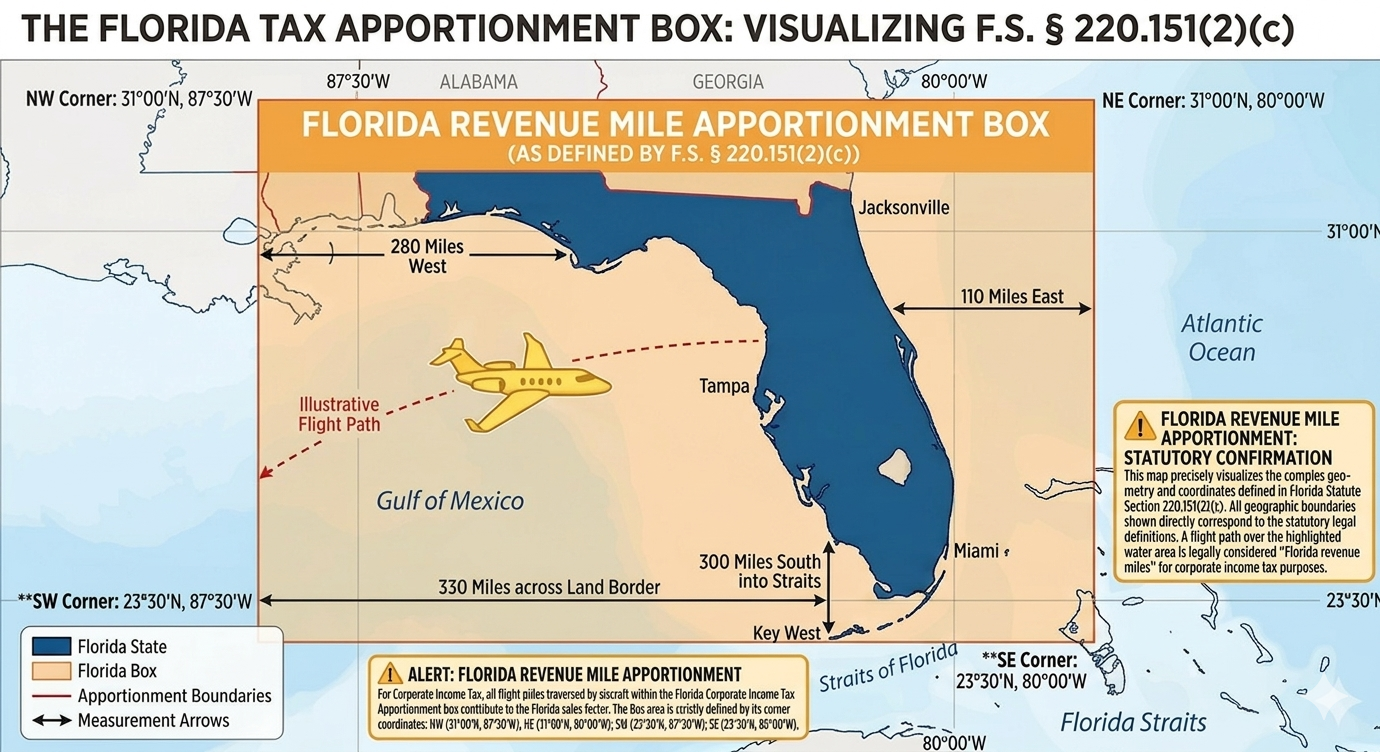
Statutory boundary per Fla. Stat. § 220.151(2)(c).
This statutory boundary includes significant portions of the Gulf of Mexico and the Atlantic Ocean contiguous to Florida. Consequently, a flight from Miami to Houston might fly hundreds of miles over water, yet every one of those miles remains "in Florida" for tax apportionment purposes.
Recent Case Law: JetBlue Airways Corp. v. Florida DOR (2025)
The constitutionality of the Florida Box has been a point of contention for decades. Major carriers like American Airlines and Frontier have historically challenged the state's right to tax miles flown over international waters.
In a landmark development, the JetBlue Airways Corp. v. Department of Revenue case reached a critical milestone in September 2025. The Florida Circuit Court entered a Final Summary Judgment in favor of the Department of Revenue, upholding the "Florida Box" formula.
Primary Authorities & Court Documents
Note: While the Circuit Court upheld the formula, JetBlue has formally filed a Notice of Appeal. The case is currently moving through the appellate courts, ensuring that the debate over statutory versus physical boundaries remains the most significant regulatory issue in aviation tax today.
"The court ruled that the tax was fair by any reasonable economic measure, noting that the formula's results were consistent with the carrier's overall economic presence in the state."
This ruling reinforces the validity of the Florida Box and confirms that operators cannot simply rely on land-based GPS polygons for their Florida tax filings. Statutory compliance is now more critical than ever.
The Challenge for Operators
Most generic mileage calculation tools only account for physical land boundaries (polygons). If an operator uses these tools for Florida filings, they are likely under-reporting their Florida revenue miles, creating a significant audit risk.
Conversely, manually calculating when an aircraft enters or exits specific latitude/longitude coordinates is labor-intensive and prone to error, especially when managing a fleet with hundreds of flight segments.
How AircraftTaxSoftware.com Solves This
Our software was built specifically to handle these regulatory nuances. Our PostGIS-powered engine supports Statutory Boundary Mapping:
- Dual-Boundary Logic: We maintain both physical US Census land boundaries and statutory tax boundaries like the "Florida Box."
- Automated Intersection: The moment you enter a flight (e.g., OPF to IAH), our system calculates the intersection of the geodesic flight path with the Florida Box coordinates automatically.
- Audit-Proof Reporting: Your quarterly and annual reports reflect the mileage figures required by § 220.151, providing a clear, defensible data trail in the event of a Florida DOR audit.
Ensure Your Apportionment is Compliant
Don't guess on your Florida filings. Start your 60-day free trial today and automate your state mileage calculations.
Start Free 60-Day Trial